
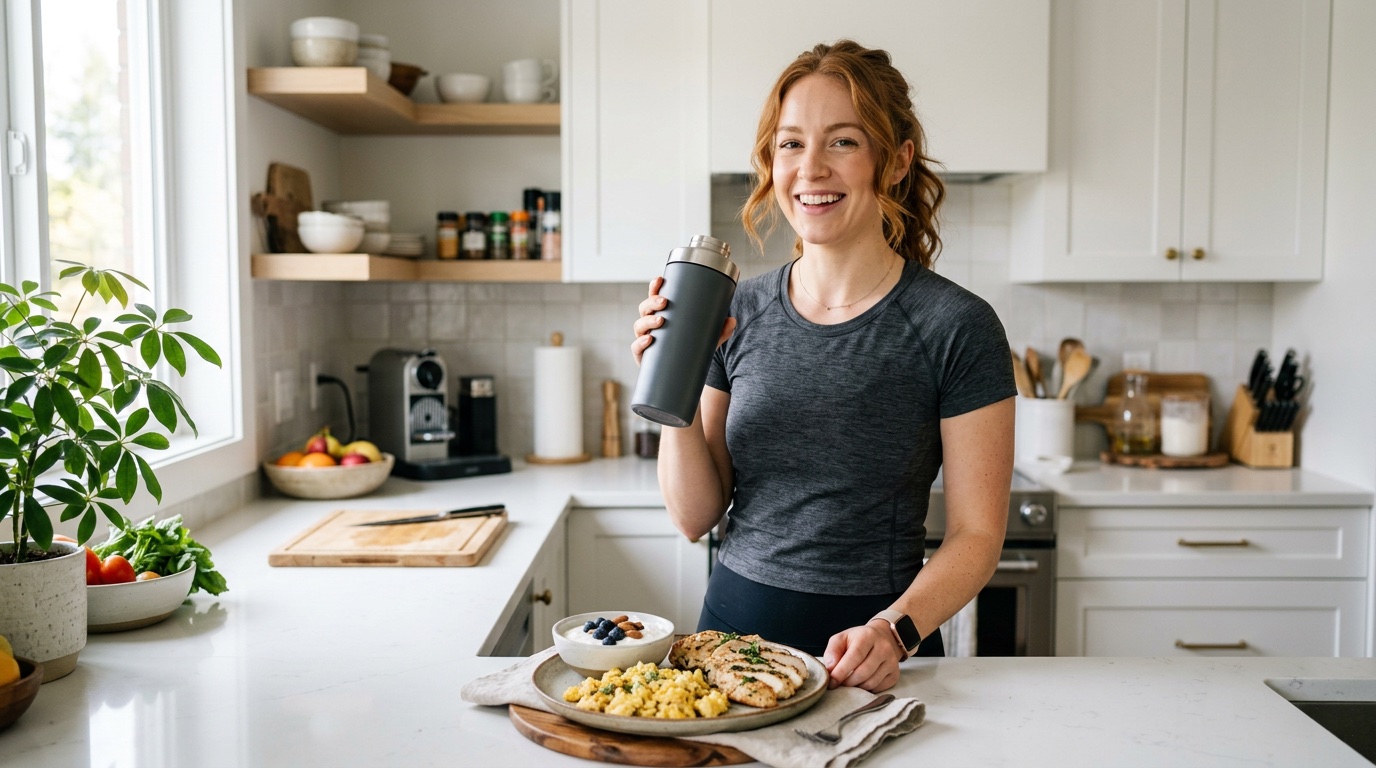
Protein is the one macro nearly everyone agrees on. Whether you follow low-carb, low-fat, Mediterranean, paleo, or "I just try to eat healthy" — the advice is the same: you're probably not eating enough protein.
And they're right. Most people aren't.
Studies consistently show that the average person gets about 60–80 grams of protein per day, while most fitness and health recommendations call for significantly more. If you're training, the gap is even wider.
The problem isn't knowledge. You know protein matters. The problem is logistics. Hitting 120, 150, or 180 grams of protein every single day is a genuine challenge — especially if you don't have the time, desire, or skill to meal prep chicken breasts every Sunday.
This guide is for you. Practical strategies, specific foods, and zero-cooking options to get your protein up without rearranging your entire life. Once protein is sorted, our step-by-step macro targets guide helps you set carbs and fat to match your goal.
Why Protein Deserves the Hype
Before we get tactical, let's be clear about why this matters — because the benefits go far beyond building muscle.
Muscle preservation during fat loss. When you're in a calorie deficit, your body breaks down both fat and muscle for energy. Adequate protein dramatically reduces muscle loss, so what you lose is predominantly fat. This is the difference between "losing weight" and actually looking lean.
Satiety. Protein is the most filling macronutrient. It suppresses ghrelin (the hunger hormone) and stimulates peptide YY (the fullness hormone). Higher protein meals keep you satisfied for hours, which makes sticking to a calorie deficit significantly easier.
Thermic effect. Your body uses about 20–30% of the calories from protein just to digest and process it, compared to 5–10% for carbs and 0–3% for fat. Eating more protein literally increases the number of calories you burn doing nothing.
Muscle growth. This one's obvious, but it bears repeating: if you're resistance training and not eating enough protein, you're leaving gains on the table. Your muscles need amino acids to repair and grow, and protein is the only macro that provides them.
Bone health, immune function, enzyme production. Protein isn't just a gym bro thing. It's foundational to basically every process in your body.
How Much Protein Do You Actually Need?
The RDA (Recommended Dietary Allowance) is 0.8 grams per kilogram of body weight — the NIH Office of Dietary Supplements summarizes how those numbers are defined for the general population. But the RDA represents the minimum to prevent deficiency — not the optimal amount for someone who exercises.
For active individuals, the research supports significantly more:
| Goal | Protein Target |
|---|---|
| General health (active) | 1.2–1.6 g/kg (0.55–0.73 g/lb) |
| Fat loss (preserve muscle) | 1.6–2.4 g/kg (0.73–1.1 g/lb) |
| Muscle building | 1.6–2.2 g/kg (0.73–1.0 g/lb) |
| Endurance athletes | 1.2–1.8 g/kg (0.55–0.82 g/lb) |
A simple rule: aim for roughly 1 gram per pound of your target body weight. If you weigh 180 lbs and want to be 165, eat around 165g of protein per day. It's not scientifically precise, but it's close enough and easy to remember.
Your Daily Protein Target
Aim for roughly 1 gram of protein per pound of your target body weight. For a 170 lb person, that's about 170g per day — split across 3–4 meals.
Protein Planner
43g per meal looks like:
Protein per Serving
Grams of protein in common foods — no cooking required for most
The Core Strategy: Protein at Every Meal
Most people eat a low-protein breakfast (cereal, toast, a banana), a moderate-protein lunch (a sandwich, maybe), and then try to cram all their protein into dinner. This doesn't work well for two reasons:
- Your body can only use so much protein per meal for muscle synthesis — roughly 30–50 grams per sitting, depending on the person.
- It's really hard to eat 100+ grams of protein in a single meal without feeling miserably stuffed.
Instead, spread it out across 3–5 eating occasions. If your target is 150g, that's 4 meals/snacks at ~38g each — much more manageable.
High-Protein Meals (Including Zero-Cooking Options)
Breakfast Ideas (25–40g protein)
Greek yogurt power bowl (no cooking) 1 cup Greek yogurt (17g) + 1 scoop protein powder (25g) + berries + granola Total: ~40g protein
Overnight protein oats (no cooking) ½ cup oats + 1 scoop protein powder + 1 cup milk + chia seeds. Mix, refrigerate overnight. Total: ~35g protein
Egg scramble (5 minutes) 3 whole eggs + 3 egg whites + cheese + vegetables Total: ~30g protein
Cottage cheese and fruit (no cooking) 1 cup cottage cheese (25g) + fruit + a drizzle of honey Total: ~27g protein
Deli turkey roll-ups (no cooking) 4 oz turkey breast slices + cheese + mustard, rolled up Total: ~28g protein
Lunch Ideas (30–45g protein)
Canned tuna salad (no cooking) 2 cans tuna (40g) + mayo + celery + crackers or bread Total: ~42g protein
Rotisserie chicken over anything (no cooking if pre-made) 6 oz rotisserie chicken + rice or salad + sauce Total: ~38g protein
Deli sandwich, upgraded (no cooking) 6 oz deli turkey or chicken + bread + cheese + vegetables Total: ~40g protein
Bean and cheese quesadilla (5 minutes) Tortilla + ½ cup black beans + cheese + salsa Total: ~30g protein
Pre-made salad + protein (no cooking) Bagged salad kit + canned chicken or pre-cooked shrimp Total: ~35g protein
Dinner Ideas (35–50g protein)
Sheet pan chicken and vegetables (15 min prep, 25 min oven) 8 oz chicken breast + roasted vegetables + olive oil Total: ~50g protein
Ground turkey stir-fry (15 minutes) 6 oz ground turkey + frozen stir-fry vegetables + soy sauce + rice Total: ~42g protein
Salmon fillet (15 minutes) 6 oz salmon + side of your choice Total: ~40g protein
Slow cooker anything (5 min prep) Throw chicken thighs, salsa, and beans in a slow cooker in the morning. Dinner's ready when you get home. Total: ~45g protein
Pasta with meat sauce (15 minutes) Pasta + 6 oz lean ground beef + jarred marinara + parmesan Total: ~45g protein
Snacks (15–25g protein)
- Beef or turkey jerky (1 bag): ~15–20g
- String cheese (2 sticks): ~14g
- Hard-boiled eggs (2 eggs): ~12g
- Protein bar: ~20g (check labels — aim for bars with 20g+ protein and under 250 calories)
- Edamame (1 cup): ~17g
- Protein shake: ~25–30g (just powder and water or milk)
- Deli meat and crackers: ~20g
- Chocolate milk (16 oz): ~16g
- Handful of almonds + a cheese stick: ~14g
The "I Don't Cook" Protein Toolkit
If your kitchen skills top out at the microwave, here's your survival kit:
Rotisserie chicken. Buy one from any grocery store. It's pre-cooked, seasoned, and gives you 3–4 meals of high-quality protein for under $8.
Canned fish. Tuna, salmon, sardines, and chicken all come in cans. Zero prep. Mix with mayo or eat straight.
Deli meat. Turkey, chicken, and roast beef from the deli counter. Roll it up, put it on bread, or eat it plain.
Pre-cooked proteins. Most grocery stores sell pre-grilled chicken strips, pre-cooked shrimp, hard-boiled eggs, and smoked salmon. They cost more than raw, but they cost less than takeout.
Greek yogurt and cottage cheese. High protein, zero cooking, endless flavor combinations.
Protein powder. Not a whole food, but a legitimately useful tool. A scoop in a shaker bottle gives you 25g of protein in 30 seconds. Mix it into oats, yogurt, or just water.
Protein Timing: Does It Actually Matter?
The short answer: a little, but not as much as total daily intake.
If you're eating enough protein spread across 3–4 meals, your timing is fine. The old "anabolic window" myth — that you must consume protein within 30 minutes of training — has been largely debunked. A window of 1–2 hours on either side of your workout is plenty.
That said, a few guidelines are worth following:
- Don't skip protein at breakfast. After 8+ hours of fasting during sleep, your body is primed to use protein. Starting the day with 25–40g sets you up for success.
- Have protein around your workout. Whether it's before, during, or after doesn't matter much. Just have some within a couple hours of training.
- Don't go more than 4–5 hours without protein. Long gaps between protein intake mean long gaps without muscle protein synthesis stimulation.
Supplements: When They Make Sense
Whole food should always be your foundation. But supplements exist for a reason — convenience.
Whey protein is the gold standard. Fast-digesting, complete amino acid profile, and available in a thousand flavors. If you're lactose intolerant, whey isolate has minimal lactose.
Casein protein digests slowly, making it ideal before bed. Mixed into Greek yogurt, it makes a thick, pudding-like snack.
Plant-based protein (pea, rice, soy blends) works well for vegans and vegetarians. Look for blends that combine sources for a complete amino acid profile.
Collagen protein supports joint and skin health but has an incomplete amino acid profile. Don't count it as your primary protein source.
A reasonable approach:
Tracking Your Progress
Knowing your protein target is step one. Knowing whether you're actually hitting it is step two.
This is where a tracking app earns its keep. If you're using something like Nour, your daily macro ring shows protein progress in real-time throughout the day, so you always know where you stand. Seeing at lunch that you're at 45g out of 160g is a lot more actionable than realizing at 9 PM that you're 80g short.
A few tracking tips:
- Log as you eat, not at the end of the day. Real-time tracking lets you course-correct. End-of-day tracking just tells you what you already ate.
- Save frequent meals. If you eat the same breakfast most days, save it. One tap instead of logging individual items.
- Use barcode scanning for packaged foods. It's faster and more accurate than searching a database.
Common Obstacles (And How to Solve Them)
"Protein is expensive."
It doesn't have to be. Eggs, canned tuna, Greek yogurt, cottage cheese, chicken thighs, ground turkey, beans, and lentils are all high in protein and cheap per gram. Protein powder, per serving, is often cheaper than meat.
"I get bored eating the same things."
Rotate through different protein sources weekly. Chicken one week, fish the next, then beef, then vegetarian options. Sauces, spices, and preparation methods can make the same protein source taste completely different.
"I'm vegetarian/vegan."
Hitting high protein targets on a plant-based diet is harder but absolutely doable. Tofu, tempeh, edamame, seitan, lentils, chickpeas, black beans, and plant-based protein powder are your heavy hitters. Combine complementary proteins (rice + beans, hummus + pita) to cover all essential amino acids.
"I feel too full."
If a high protein target makes you uncomfortably full, try these adjustments:
- Choose leaner protein sources (they're less filling per gram than fatty ones).
- Use liquid protein (shakes, smoothies) — liquids don't fill you up as much as solid food.
- Spread intake across more meals (5 smaller meals instead of 3 larger ones).
- Gradually increase over two weeks rather than jumping to your target overnight.
"I forget to eat protein at breakfast."
Set a default breakfast that requires zero thought. Overnight oats with protein powder. Greek yogurt with fruit. Two hard-boiled eggs and toast. Prep it the night before or keep the ingredients stocked. Make it your "autopilot" meal.
Your Protein Game Plan
- Know your number. Use roughly 1g per pound of target body weight.
- Build meals around protein first. Choose your protein source, then add carbs and fats around it.
- Never eat a meal with zero protein. Every meal and snack should have at least some.
- Keep grab-and-go options stocked. Jerky, protein bars, string cheese, yogurt cups, deli meat. Always have something available.
- Use supplements strategically. Fill the gaps, not the whole diet.
- Track for awareness. Even a few weeks of logging protein intake teaches you more about food than years of guessing.
Hitting your protein goals isn't about willpower or cooking talent. It's about systems — having the right foods available, the right habits in place, and the right awareness of where you stand each day. Once those systems are set up, it stops being a struggle and starts being automatic.
You don't need to become a chef. You just need a plan.
See your protein progress in real-time and hit your daily target with effortless logging.
Try Nour Free