
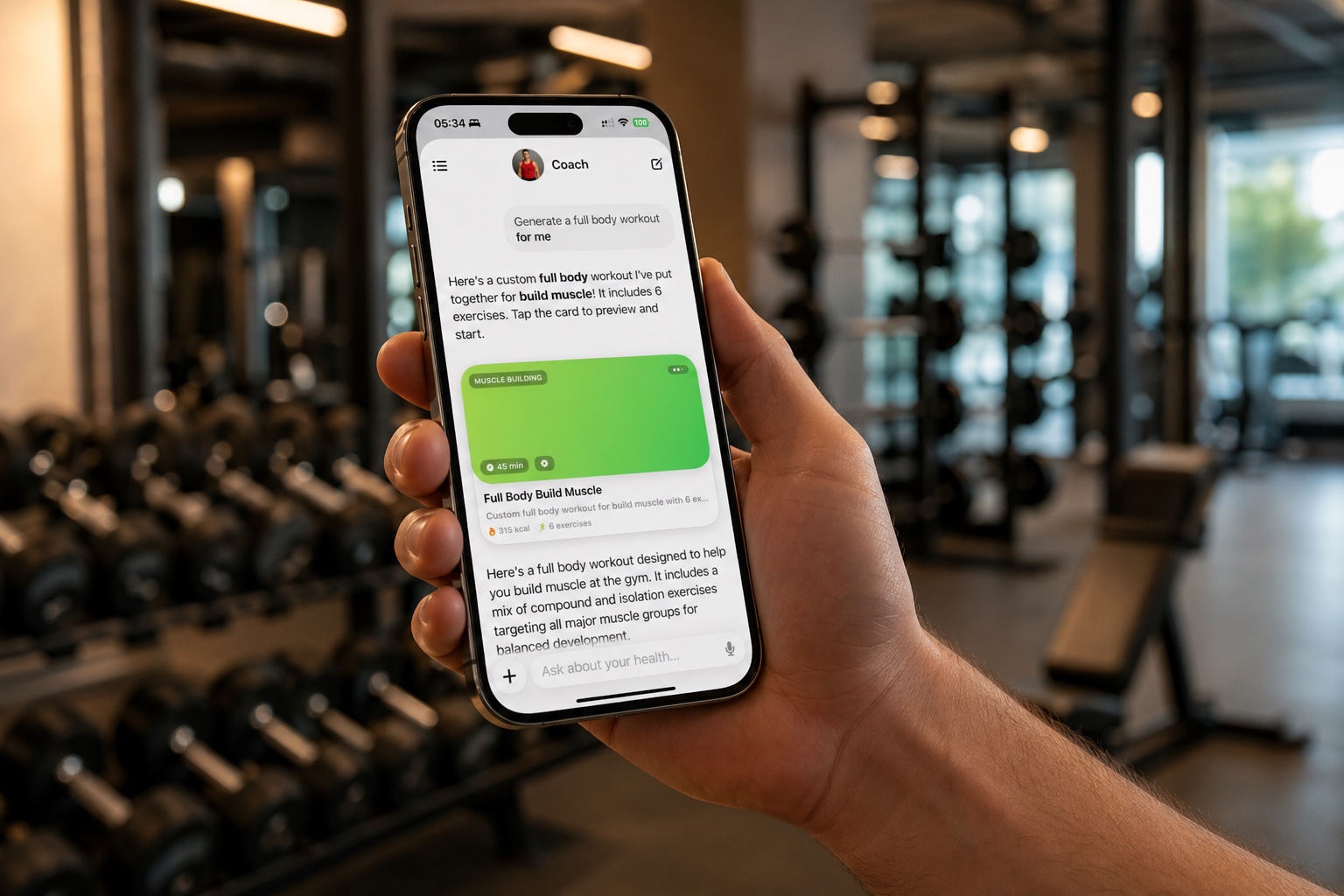
The fitness industry has always had a coaching gap. On one side, you have generic workout programs that don't adapt to you. On the other, personal trainers charging $80–200 per session. AI coaching sits in the middle — personalized, responsive, and available 24/7 at a fraction of the cost.
But what does "AI coaching" actually mean? Is it just a chatbot telling you to do more push-ups? Let's break down how modern AI fitness coaching really works. If you are comparing AI to a human coach, can an AI replace your personal trainer? is the honest tradeoff guide.
The Three Layers of AI Coaching
Effective AI coaching isn't a single technology — it's a stack of systems working together.
Layer 1: Data Collection
Before an AI coach can help you, it needs to understand you. This starts with:
- Activity data — steps, workouts, heart rate zones, active calories
- Nutrition data — meals logged, macro breakdown, caloric intake
- Recovery signals — sleep duration, sleep quality, resting heart rate, HRV
- Historical patterns — how your body responds to different training loads over weeks and months
The more data the system has, the more personalized its recommendations become. This is why integration with platforms like Apple Health, Garmin, and Strava matters — they provide a continuous stream of physiological data.
Layer 2: Pattern Recognition
Raw data is meaningless without interpretation. The AI layer analyzes your data to identify:
- Training readiness — are you recovered enough for an intense session, or should today be lighter?
- Progressive overload opportunities — when performance on a lift plateaus vs. when you're ready to increase weight (the same principle we explain in progressive overload explained)
- Nutritional gaps — consistently low protein on rest days, or inadequate carbs before heavy training
- Recovery bottlenecks — correlating poor sleep with decreased workout performance
This is where AI fundamentally differs from static workout programs. A program doesn't know you slept 4 hours last night. An AI coach does.
Layer 3: Actionable Recommendations
The final layer translates insights into specific, timely advice:
- "Your HRV is 15% below baseline — today's session should be moderate intensity"
- "You've hit 4x8 at 135 lbs on bench for three consecutive sessions — try 140 lbs next time"
- "Your protein intake has averaged 95g over the past week — aim for 130g to support your training volume"
- "You've trained 5 days in a row. Consider a rest day tomorrow"
The key word is timely. These recommendations arrive when they're relevant, not buried in a generic weekly email.
What AI Coaching Can Do Today
Adaptive Training Programs
AI coaches can build and modify workout programs in real time. If you miss a session, the program adjusts. If you're ahead of schedule on a lift, it progresses you faster. If you report joint discomfort, it substitutes exercises.
This level of responsiveness was previously only possible with an in-person trainer watching you train.
Nutrition Insights
Modern AI can analyze meal photos to estimate macros, identify patterns in your eating habits, and suggest adjustments. It can tell you:
- You tend to under-eat protein on weekends
- Your carb intake drops too low before heavy training days
- You're consistently 300 calories above target on Fridays
Recovery Optimization
By combining sleep data, heart rate variability, training load, and subjective feedback ("How do you feel today?"), AI coaches can optimize your recovery:
- Suggesting deload weeks before burnout hits
- Recommending sleep hygiene improvements based on your data
- Balancing training volume across the week to prevent overreaching
Natural Language Interaction
Modern AI coaches understand conversational questions:
- "Should I train today?"
- "What should I eat before my evening run?"
- "I have 30 minutes — give me a quick upper body workout"
- "Why has my bench press stalled?"
The AI can reference your specific data to give answers tailored to your situation, not generic advice.
What AI Coaching Can't Do (Yet)
It's important to be honest about limitations:
- Form correction — AI can't watch you squat and fix your knee cave (though video-based form analysis is emerging)
- Motivation on your worst days — an AI can nudge, but it can't replace the accountability of a human who knows you personally
- Medical advice — AI coaches are wellness tools, not healthcare providers. They should never replace professional medical guidance
- Emotional context — an AI doesn't know you're going through a breakup or just got promoted. A good human coach factors life stress into training recommendations
AI Coaching vs. Human Coaching
This isn't an either/or question. They serve different needs:
| Factor | AI Coaching | Human Coaching |
|---|---|---|
| Cost | $5–15/month | $200–800/month |
| Availability | 24/7, instant | Scheduled sessions |
| Personalization | Data-driven, pattern-based | Intuitive, relationship-based |
| Form feedback | Limited | Excellent |
| Accountability | Automated nudges | Personal relationship |
| Scalability | Handles thousands of users | 15–30 clients max |
The ideal setup for many people is AI coaching for daily guidance combined with periodic human check-ins for form review and program strategy.
How Nour Approaches AI Coaching
At Nour, our AI coaching philosophy is built on three principles:
- Calm, not shouty — recommendations are suggestions, not demands. We trust you to make the final call.
- Data-first — every recommendation is backed by your actual data, not population averages.
- Privacy-respecting — your health data stays encrypted and under your control. We never sell it.
The AI learns your patterns over weeks and months, becoming more useful the longer you use it. It's not trying to replace your judgment — it's trying to augment it with information you wouldn't have otherwise.
Experience AI coaching that adapts to your data, respects your autonomy, and actually helps you train smarter.
Try Nour FreeThe Future of AI Coaching
We're still early. In the next few years, expect:
- Real-time form analysis via phone camera during workouts
- Predictive injury prevention based on movement patterns and load history
- Deeper biometric integration — continuous glucose monitors, advanced sleep staging, muscle oxygen sensors
- Multi-modal coaching — voice-based interaction during workouts, haptic cues from wearables
The goal isn't to replace human expertise. It's to make personalized, data-driven coaching accessible to everyone — not just those who can afford $200/hour.
Getting Started
If you've never tried AI coaching, start with these steps:
- Connect your health data sources (Apple Health, wearables, etc.)
- Log meals consistently for one week to establish a baseline
- Train with tracking enabled so the AI can learn your patterns
- Ask questions — the more you interact, the more useful it becomes
Give it 2–3 weeks of consistent data before judging the recommendations. Like any good coach, it needs time to learn who you are.